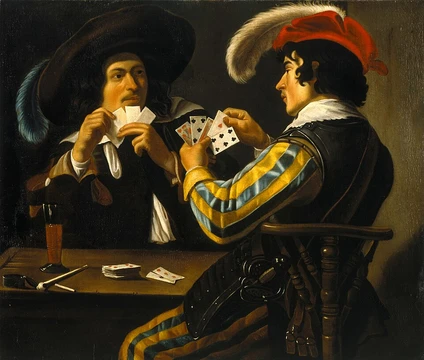
Baccarat
A comparing card game with three possible outcomes per round.

Havang(nl) · CC0
Baccarat or baccara is a comparing card game played between two hands, the 'player' and the 'banker'. It is now played mainly at casinos, but in the past it was also popular at house parties and private gaming rooms. The game's immediate precursor is Macao, a European game that likely inspired the modern version, and it gained popularity in Europe, with a faster French variant emerging. The most common version today is of Cuban origin.
- Type
- Card game
- Variants
- Punto banco, baccarat chemin de fer, baccarat banque
- Origin
- Introduced to France from Italy at the end of the 15th century; immediate precursor is the European game Macao
- House edge
- Varies by bet: banker ~1.06%, player ~1.24%, tie ~14.4%
- Highest hand value
- Nine
- Popular modern form
- Punto banco, developed in Havana in the 1940s
Lore & Background
The origins of baccarat are disputed. Some sources claim it dates to the 19th century, but the most widely accepted history says it was introduced into France from Italy at the end of the 15th century by soldiers returning from the Italian Wars during the reign of King Charles VIII. David Parlett considers Macao the immediate precursor, a European game derived from earlier European card games, not East Asian ones.
Reader's Guide
Baccarat has been popular among the French nobility since the 19th century. Baccarat Banque is the earliest form, a three-person game mentioned in Album des jeux by Charles Van-Tenac. Chemin de Fer emerged later as a two-player zero-sum game, first appearing in the late 19th century; its name, French for 'railway,' reflects it being quicker than the original. This version remains the most popular in France. Baccarat Punto Banco, where the bettor bets on whether the Player or Banker hand wins, developed into a house-banked game in Havana in the 1940s and is now the most popular modern form worldwide. In punto banco, the casino banks the game and uses fixed drawing rules, making it a pure game of chance. The game is frequented by high rollers in the U.S., with minimum bets often starting at $100.
Did You Know?
- The highest possible hand value in baccarat is nine.
- Baccarat has three popular variants: punto banco, baccarat chemin de fer, and baccarat banque.
- The game's immediate precursor is Macao, a European game, not an East Asian one.
- Punto banco developed into a house-banked game in Havana in the 1940s.
Origins & Historical Spread
The true birthplace of baccarat remains a matter of scholarly debate. Some historians trace the game to the late fifteenth century, when French soldiers returning from the Italian Wars under King Charles VIII allegedly carried it from Italy to France. Other scholars, including David Parlett, point instead to Macao as the immediate ancestor, noting that its name and structure echo card games played across East Asia since the early seventeenth century—titles such as San zhang, Oicho-Kabu, and Gabo japgi all share the core idea of comparing two hands. Macao surfaced in European salons by the close of the eighteenth century, winning devotees across every social class. Despite repeated bans, the card never lost its grip on high society. In the United States its following faded after the early 1900s, yet in Continental Europe—particularly Russia, where it was likewise prohibited during the nineteenth century while its rules kept appearing in printed game books—the game retained a devoted audience well into the modern era.
Social Scandals & Cultural Footprint
Baccarat's allure made it as much a social spectacle as a card game, and its history is littered with controversies that reached the highest echelons of power. At Watier's, an exclusive gentlemen's club in London, the game was the most popular pastime—and it was there that Beau Brummell, the dashing dandy, saw his fortune destroyed at the table. The Prince of Wales, the future King Edward VII, was compelled to take the witness stand in court over what became known as the Royal baccarat scandal. The game's cultural penetration was so deep that even after it was banned in multiple countries, its rules continued to be printed in reference books, ensuring that the knowledge of how to play passed from one generation of aficionados to the next.
From Player's Choice to the House Bank
The evolution of baccarat's variants tells a story of increasing speed and decreasing player agency. The earliest documented form, Baccarat Banque, was a three-person game referenced in Charles Van-Tenac's Album des jeux, and it gave both sides the freedom to make drawing decisions. From this foundation emerged Chemin de Fer in the late nineteenth century, a two-player zero-sum version whose name—French for "railway"—reflected the era's association of the railway with speed; the game was simply quicker to play than its predecessor. Chemin de Fer remains the most popular variant in France to this day. The most consequential transformation came with Punto Banco, which stripped away individual choice entirely: the casino banks the game at all times and commits to fixed drawing rules, so that the player and banker hands are merely designations for two dealt-out hands rather than roles held by specific gamblers. Punto Banco crystallized as a house-banked game in Havana during the 1940s and has since become the dominant form in most parts of the world, including the United States, where it is the most widely played version of baccarat.
Anatomy of a Coup
A single round of baccarat, called a coup, follows a tightly choreographed sequence. In the modern Punto Banco format, the dealer works from a shoe holding six or eight shuffled decks, with a cut card positioned before the seventh-from-last card to signal the final coup. The dealer burns one card face up, then burns additional cards face down equal to that card's value. Two cards are dealt face up to each hand, alternating between player and banker. If either hand totals eight or nine—a "natural"—the coup ends immediately. Otherwise, the tableau of drawing rules is consulted: the player draws a third card on an initial total of five or less and stands on six or seven. The banker's decision to draw or stand then depends on the value of any card the player received. Hand values use modulo-ten arithmetic: cards two through nine carry face value, tens and face cards are worth zero, and aces are worth one, making nine the highest possible total. Because every move is dictated by the cards rather than a gambler's judgment, Punto Banco is a pure game of chance, with a house edge of at least one percent favouring the bank.
Gallery

More in Card Games 1-22
Spotted an error? Know more?
This is a living reference — every entry is fact-audited, and reader corrections feed straight into our audit queue. Suggest an edit · See this site's audit record