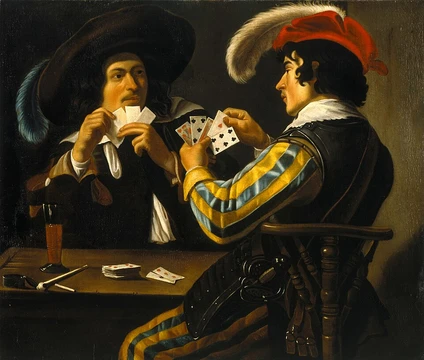
Durak
Traditional Russian card game where the last player holding cards loses.

Roberta · CC BY 2.0
Durak (Russian: дурак, IPA: [dʊˈrak]; lit. 'fool') is a traditional Russian card game that is popular in many post-Soviet states. It is Russia's most popular card game, having displaced Preferans. The objective of the game is to shed all one's cards when there are no more cards left in the deck; the last player with cards in their hand is the durak or 'fool'.
- Origin
- Late 18th-century Russian Empire
- Players
- 2 to 5 (up to 6)
- Deck
- 36 cards (standard 52-card deck minus 2 through 5)
- Card ranking
- 6 7 8 9 10 J Q K A (ace high)
- Known for
- Most popular card game in Russia and post-Soviet states
Lore & Background
Initially a social pastime of uneducated peasants and industrial workers, after the October Revolution Durak spread to numerous social levels by mid-20th century to soon become the most popular Soviet card game. The game is typically played with two to five people, using a deck of 36 cards, with the bottom card of the stock determining the trump suit. Each player is dealt six cards, and the player with the lowest trump card becomes the first attacker. The defender must beat attack cards by playing a higher card of the same suit or a trump card. If the defender cannot or will not beat an attack, they pick up all cards played that round. The last player left with cards is the loser, called the durak. Variants include Perevodnoy durak, where a defender may pass an attack to the next player if they hold a card of the same rank. Team play is possible with two pairs or three teams of two. A special rule, 'fool with epaulettes,' applies if the last card played by an attacker is a six and the defender loses.
Reader's Guide
Durak holds a unique place in Russian and post-Soviet culture as the most popular card game, having displaced the earlier Preferans. Its origins among uneducated peasants and industrial workers, followed by its spread after the October Revolution to all social levels, reflect broader social changes in the region. The game's simple objective—avoid being the last player holding cards—belies a strategic depth involving trump suits, sequential attacks, and the option to pass attacks in some variants. The 'fool with epaulettes' rule adds a layer of humiliation for losing to a low six. Durak's enduring popularity in post-Soviet states and its spread to other parts of the world demonstrate its cultural resonance. The game's flexibility, accommodating two to six players and team play, contributes to its widespread appeal. Its legacy is as a social equalizer, where the only outcome is a single loser, the durak, and no formal winner is declared in some variants.
Did You Know?
- Durak is Russia's most popular card game, having displaced Preferans.
- If the last card played by an attacker is a six and the defender loses, the defender is called a 'fool with a necktie' (durak s galstukom).
- In the Perevodnoy variant, a defender may pass the attack to the next player if they have a card of the same rank.
Origins and Social Rise
Durak traces its roots to the late 18th century within the Russian Empire, where it first took shape as a casual pastime among uneducated peasants and industrial workers. For decades it remained a lower-class diversion, but the social upheaval following the October Revolution shattered those class boundaries. By the mid-20th century, Durak had permeated every stratum of Soviet society and firmly established itself as the nation's most beloved card game, effectively displacing the older, more aristocratic Preferans. Its popularity did not stop at the borders of the former USSR; the game spread throughout post-Soviet states and eventually gained recognition in other parts of the world, carrying with it the simple, biting irony of its name—literally "fool"—as a lighthearted jab at the last player still holding cards.
Table Setup and the 36-Card Deck
A standard Durak table accommodates two to five players, with a theoretical maximum of six when using a single deck. The deck itself is a 36-card subset of the familiar 52-card pack, created by stripping out the twos through fives so that the remaining ranks run from six up to ace. Each participant receives six cards, and the bottom card of the remaining stock is flipped face up to announce the trump suit for that deal—say, a seven of diamonds makes diamonds the dominant suit for the entire round. The rest of the pack is laid perpendicular to that turn-up card, forming what is called the prikup or talon, with the turn-up remaining as its final draw. A separate discard pile sits beside the talon to collect cards from successfully defended rounds. The six-player configuration, while possible, introduces a pronounced imbalance: the first attacker gains a significant structural edge while the first defender is at a corresponding disadvantage, which is why most groups cap the table at five.
The Attack-Defence Core
The heart of Durak is a relentless back-and-forth between an attacker and a defender. The player holding the lowest trump card opens the first attack, though they are under no obligation to lead with that specific card. They lay a card face up, and the player to their left must respond with a higher card of the same suit or any trump card, placing it overlapping the attack so both remain visible. If the defence holds, the attacker may pile on another card—but only matching the rank of a card already on the table—and other players can join the assault in clockwise priority order. A single round caps at six attacking cards. If the defender cannot or will not beat the latest card, they surrender: they must scoop up every card from that round, attacking and defending alike, while other players get the chance to shed matching-rank cards onto the pile before the defender collects them all. A successful defence, by contrast, sends the entire row to the discard pile and hands the attacker role to the defender for the next round.
The Fool and the Endgame
The game's title is not merely a nickname; it is the literal fate of the last player still holding cards once the deck runs dry. The objective is deceptively simple—shed all of your cards before the stock is exhausted—yet the path to that goal is a long negotiation of risk and timing. After every round, whether the defence succeeded or the defender capitulated, all players draw back up to six cards from the talon, with the main attacker drawing first and the remaining players following in clockwise order. The discard pile, which accumulates cards from every successfully defended round, is strictly off-limits: no player may examine it at any point, preserving an element of uncertainty about what has already been played. Variants that employ multiple decks extend the game further, but the fundamental tension remains unchanged. Whoever is left clutching cards when the talon is empty earns the title of durak, and the game's enduring appeal lies in that blend of straightforward rules, cascading social pressure, and the ever-present threat of being the one who must pick up the whole pile.
Gallery






More in Card Games 1-22
Spotted an error? Know more?
This is a living reference — every entry is fact-audited, and reader corrections feed straight into our audit queue. Suggest an edit · See this site's audit record