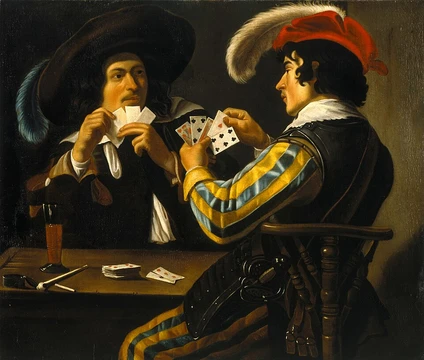
Crazy Eights
A classic American discard game from the Eights Group.

via Wikipedia: Crazy Eights · see source
Crazy Eights is a card game for two to seven players and the best known American member of the Eights Group, which also includes Switch, Mau-Mau, Whot!, and Uno. The object of the game is to be the first player to discard all of their cards. Originally this was played primarily by children with the left over cards not used in Euchre. Now a standard 52-card deck is used when there are five or fewer players. When there are more than five players, two decks are shuffled together and all 104 cards are used.
- First appeared
- 1930s as Eights
- Name Crazy Eights dates to
- 1940s
- Number of players
- 2 to 7
- Deck
- Standard 52-card deck (or 104 cards for >5 players)
- Object
- Be first to discard all cards
- Known for
- Best known American member of the Eights Group
Lore & Background
The game first appeared as Eights in the 1930s, and the name Crazy Eights dates to the 1940s, derived from the United States military designation for discharge of mentally unstable soldiers, Section 8. It may have derived from the German game of Mau-Mau. There are many variations of the basic game, under names including Craits, Last card, and Switch. Bartok, Mao, Taki, and Uno add further elements to the game. David Parlett describes Crazy Eights as 'not so much a game as a basic pattern of play on which a wide variety of changes can be rung,' noting that players can easily invent and explore new rules.
Reader's Guide
Crazy Eights is significant as the best known American representative of the Eights Group of card games, a family that includes popular titles like Uno and Mau-Mau. Its simple core mechanic—discarding by matching rank or suit, with eights as wild cards—has made it a staple of casual play. The game's adaptability is its greatest legacy; card game historian John McLeod describes it as 'one of the easiest games to modify by adding variations.' Common variant rules include Queens skipping turns, Aces reversing direction, and twos forcing draws. A popular American variant, Crazy Eights Countdown, ties a player's score to the number of cards dealt and which rank is wild. The game's scoring system, where eights count 50 points and court cards 10, and the winner is the first to reach a point total equal to the number of players multiplied by 50, provides a structured endpoint. Its influence is seen in numerous commercial and homemade variations, cementing its place as a flexible and enduring pastime.
Did You Know?
- The name 'Crazy Eights' dates to the 1940s and derives from Section 8, the U.S. military designation for discharge of mentally unstable soldiers.
- The game first appeared as Eights in the 1930s and may have derived from the German game of Mau-Mau.
- Originally, Crazy Eights was played primarily by children with leftover cards not used in Euchre.
- In the scoring system, 8s are worth 50 points, court cards 10, and all other cards their face value.
- The winner is the first player to reach a point total equal to the number of players multiplied by 50.
Origins & Etymology
Crazy Eights traces its earliest documented appearance to the 1930s, when it was simply known as Eights. The more colorful name we recognize today emerged in the 1940s, and its etymology is rooted in American military culture. The title references Section 8, the U.S. military designation used for discharging soldiers deemed mentally unstable—a nod that captures the game's chaotic, rule-bending spirit. Some scholars also trace the game's lineage back to the German card game Mau-Mau, suggesting a transatlantic evolution of the basic mechanics. In its earliest days, Crazy Eights was largely a children's pastime, played with the surplus cards left over after a round of Euchre. Over time it outgrew that humble origin and became a standalone game in its own right. Card game scholar David Parlett captured the game's nature well, describing it not as a fixed game but as a foundational pattern of play around which an almost limitless variety of modifications can be built. This open-ended quality has been central to its identity since the very beginning.
Core Mechanics & Play
At its heart, Crazy Eights is a straightforward shedding game for two to seven players. Each participant receives five cards at the start (seven in a head-to-head game), and the remaining deck forms a face-down stock pile. The top card is flipped to open the discard pile, and play begins with the player seated to the dealer's left. On a turn, a player must either match the rank or suit of the top discard, or play an 8 to declare a new suit for the next player. If no legal play exists, the player draws from the stock until a playable card appears or the stock is exhausted. Notably, a player may choose to draw at any point, even when holding a playable card, adding a layer of strategic timing. When the stock runs dry, the played cards except the top one are reshuffled into a new stock. The round concludes the moment any player discards their final card, triggering a scoring exchange with every remaining opponent.
The Eights Family & Variations
Crazy Eights sits at the center of what is often called the Eights Group, a family of related shedding games that also includes Switch, Mau-Mau, Whot!, and Uno. Card game historian John McLeod has noted that Crazy Eights is among the easiest card games to modify, and the evidence is overwhelming. Common house rules include Queens that cause the next player to skip their turn, Aces that reverse the direction of play, and Twos that force the following player to draw two cards—unless they respond with another Two, creating a stacking effect. Beyond these tweaks, entirely new games have grown from the same skeleton: Bartok, Mao, Taki, and Uno each layer additional mechanics on top of the core pattern. In the United States, a particularly popular spin-off called Crazy Eights Countdown reimagines the scoring entirely. Players begin with a score of eight, which determines both the number of cards dealt and which rank is wild for them. The goal flips from accumulating points to driving that number down to zero, creating a tense, shrinking game that many consider the most elegant variant in the family.
Scoring & Competitive Structure
The competitive framework of Crazy Eights is deceptively simple yet rewards sharp arithmetic. When a player empties their hand, every opponent pays them a sum based on the cards still in their grip: eights are worth fifty points each, court cards ten, and all remaining cards their face value. If the entire deck is exhausted before anyone goes out, the player holding the lowest-scoring hand collects the difference between their total and each opponent's. The match itself is won by the first player to reach a target score calculated by multiplying the number of participants by fifty—so a two-player duel requires one hundred points, while a full seven-player table demands three hundred and fifty. For games with five or fewer players, a single standard fifty-two-card deck suffices; beyond that, two decks are combined into a one-hundred-and-four-card pool. This scaling ensures the game remains balanced whether played as a quick two-person contest or a lively family gathering around the kitchen table.
Gallery
More in Card Games 1-22
Related in Card Games
Links follow this subject's own source article.
Spotted an error? Know more?
This is a living reference — every entry is fact-audited, and reader corrections feed straight into our audit queue. Suggest an edit · See this site's audit record