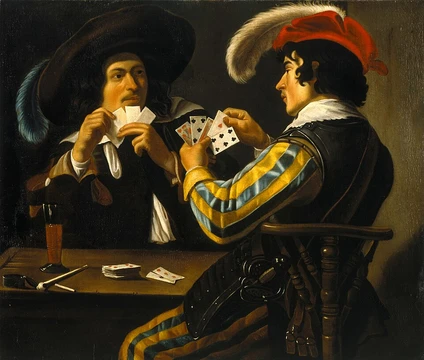
Blackjack
A comparing card game where players compete against the dealer.

gnokii · CC0
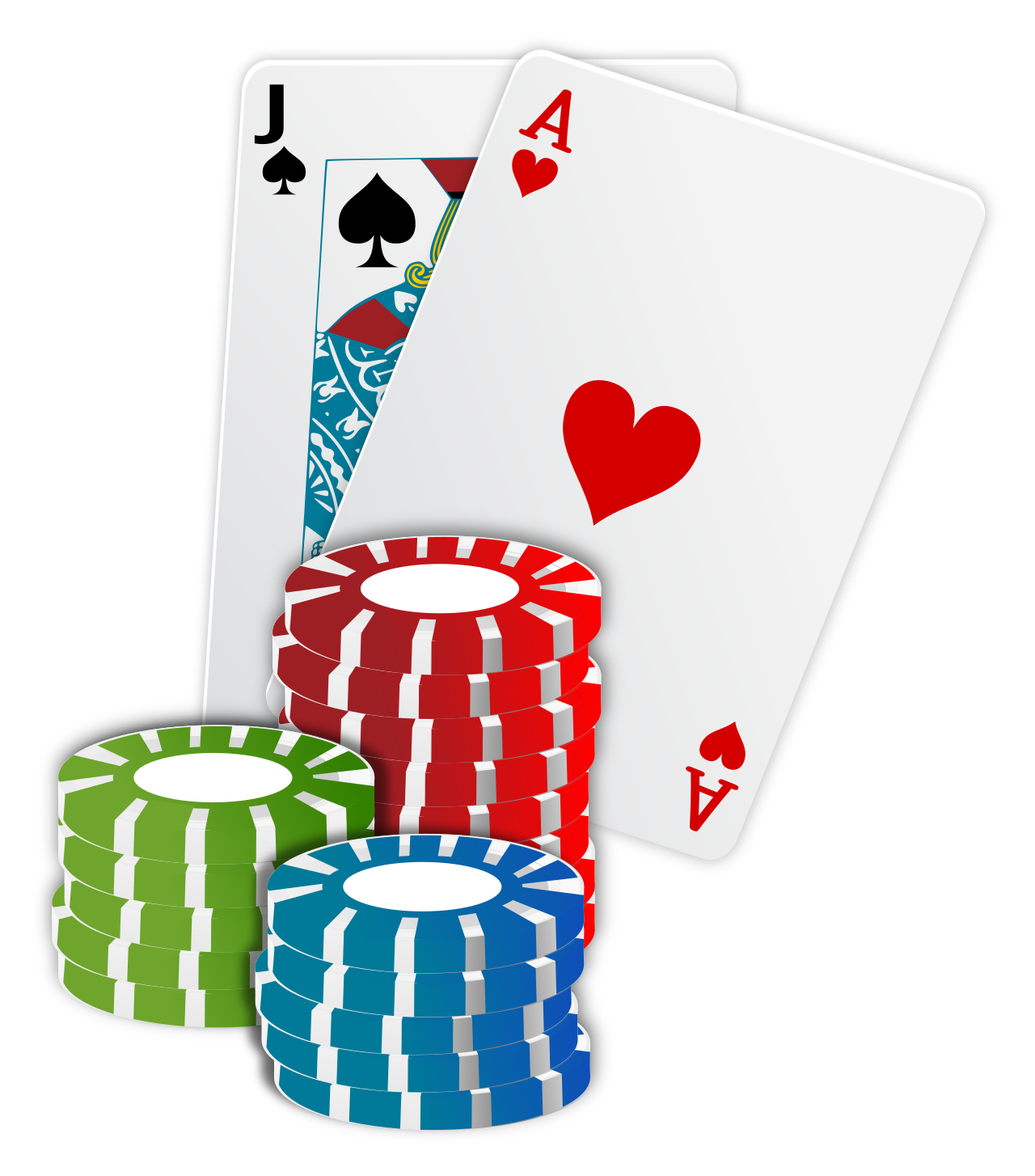
Blackjack is a casino banking game and the most widely played casino banking game in the world. It uses decks of 52 cards and descends from a global family of casino banking games known as 'twenty-one,' which includes European games such as vingt-et-un and pontoon, and the Russian game Ochko. The game is a comparing card game where players compete against the dealer, rather than each other.
- precursor
- Spanish game veintiuno
Lore & Background
The first written reference is found in a book by the Spanish author Miguel de Cervantes, whose protagonists in 'Rinconete y Cortadillo' are card cheats proficient at veintiuno, the object being to reach 21 points without going over, with ace values of 1 or 11.
Reader's Guide
Blackjack's significance lies in its evolution from earlier twenty-one games and its development into the dominant casino banking game worldwide. The game's history includes a popular myth that the name 'blackjack' originated from a ten-to-one bonus payout for the ace of spades and a black jack, though French card historian Thierry Depaulis debunks this, suggesting the name came from prospectors during the Klondike Gold Rush who transferred the mineral name 'blackjack' (zincblende) to the top bonus hand of an ace and any 10-point card. The game's rules involve players trying to create card totals higher than the dealer's without exceeding 21, with number cards counting as their number, face cards as 10, and aces as 1 or 11. A total of 21 on the starting two cards is called a 'blackjack' or 'natural' and is the strongest hand.
Did You Know?
- The game was originally called vingt-un in English and was renamed 'blackjack' in the early 20th century.
- French card historian Thierry Depaulis suggests the name 'blackjack' came from the mineral zincblende, associated with gold or silver deposits.
Origins and Global Heritage
Blackjack belongs to a worldwide family of twenty-one banking games that also includes France's vingt-et-un, Britain's pontoon, and Russia's Ochko. The earliest documented mention traces back to the Spanish author Miguel de Cervantes, who was himself a gambler. The game was played with the Spanish baraja deck, placing its existence in Castile by the early 17th century at the latest.
The Naming Mystery
The origin of the name blackjack is wrapped in a popular legend that has been thoroughly challenged. The myth holds that when the game arrived in America, gambling houses offered a ten-to-one bonus payout for a hand consisting of the ace of spades paired with a black jack, either the jack of clubs or the jack of spades. According to this story, the name stuck even after the special bonus was eventually withdrawn. However, French card historian Thierry Depaulis dismantled this narrative. He found no historical evidence supporting a special bonus for an ace paired specifically with a black jack. The bonus hand in question was simply an ace with any ten-point card. Depaulis proposed that the name originated from zincblende, a mineral associated with gold and silver deposits, which prospectors transferred to the top bonus hand in the card game.
The Mathematical Revolution
For centuries, blackjack was treated as a game of pure luck. This was the first mathematically sound optimal strategy for the game, representing a fundamental shift in how players understood their odds at the table. The paper's hand calculations became the foundation for all future efforts to beat blackjack. Thorp's book brought the mathematical approach to a wider audience and demonstrated that disciplined strategy could alter a player's standing against the dealer.
Table Mechanics and Regional Variations
The physical and procedural details of a blackjack table reveal significant regional differences. At a standard casino table, the dealer sits behind a semicircular layout facing five to nine playing positions, with between one and eight standard 52-card decks shuffled together. Players place bets in designated betting boxes, and in jurisdictions permitting back betting, up to three players can occupy a single position, with the front bettor controlling decisions. The dealing order proceeds clockwise from the dealer's left, called first base, to the far right, third base. A critical distinction separates American and European play: in hole card games, the dealer receives a second face-down card and may peek to check for a blackjack, sometimes using a small mirror or electronic sensor. In European casinos, no hole card games are prevalent, meaning the dealer's second card is not drawn until all players have completed their hands. Players' initial cards may be dealt face-up or face-down, with the latter more common in single and double-deck games. In regulated jurisdictions like New Jersey, table layouts must display applicable payout rules, dealer drawing procedures, and insurance terms, with a maximum of seven wagering areas on standard layouts.
Gallery

More in Card Games 1-22
Spotted an error? Know more?
This is a living reference — every entry is fact-audited, and reader corrections feed straight into our audit queue. Suggest an edit · See this site's audit record