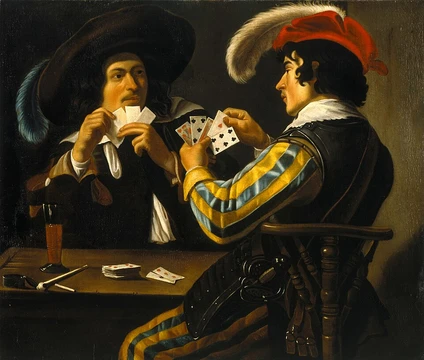
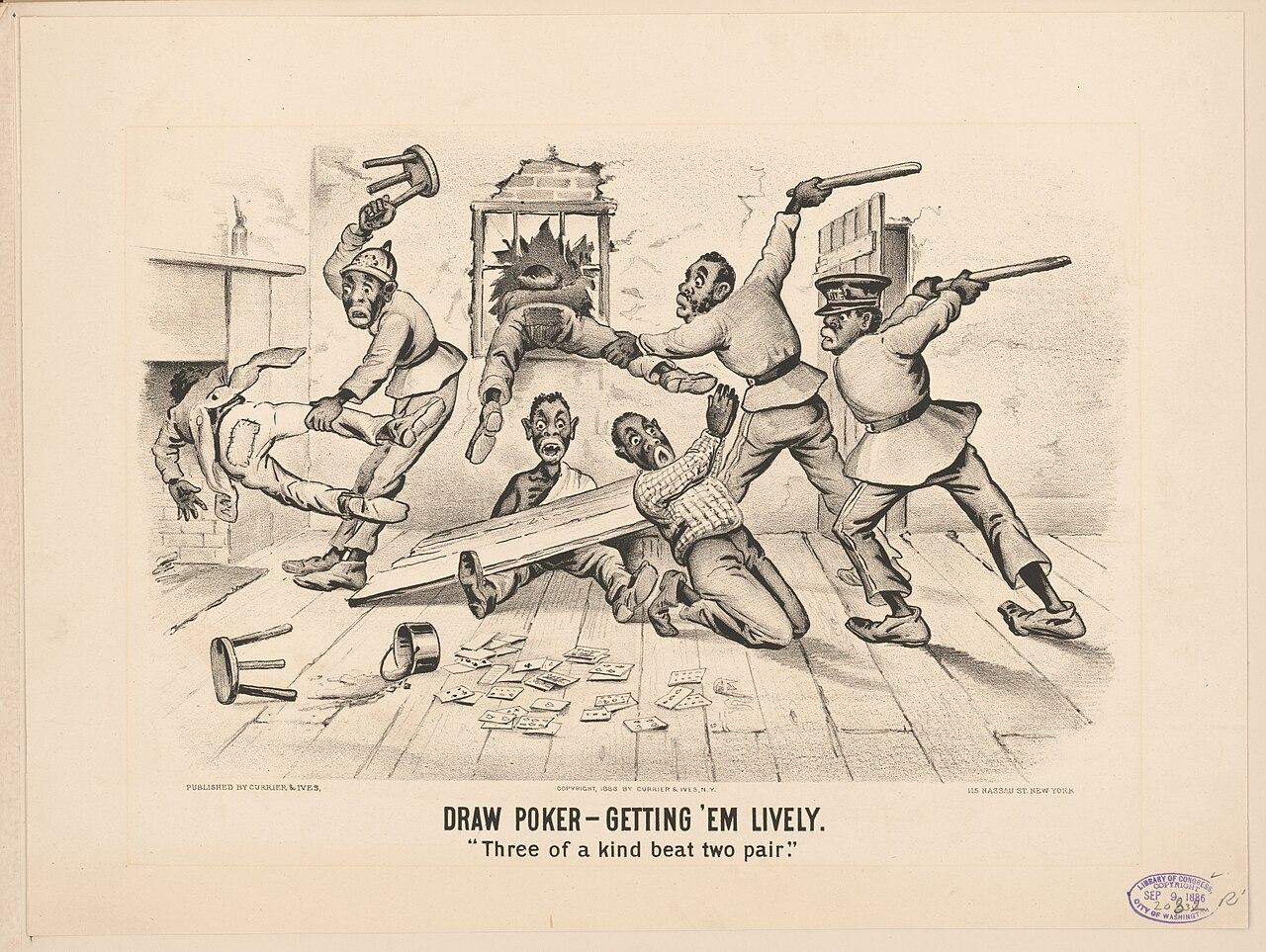
Draw poker
A poker family where players draw cards to improve their hands.

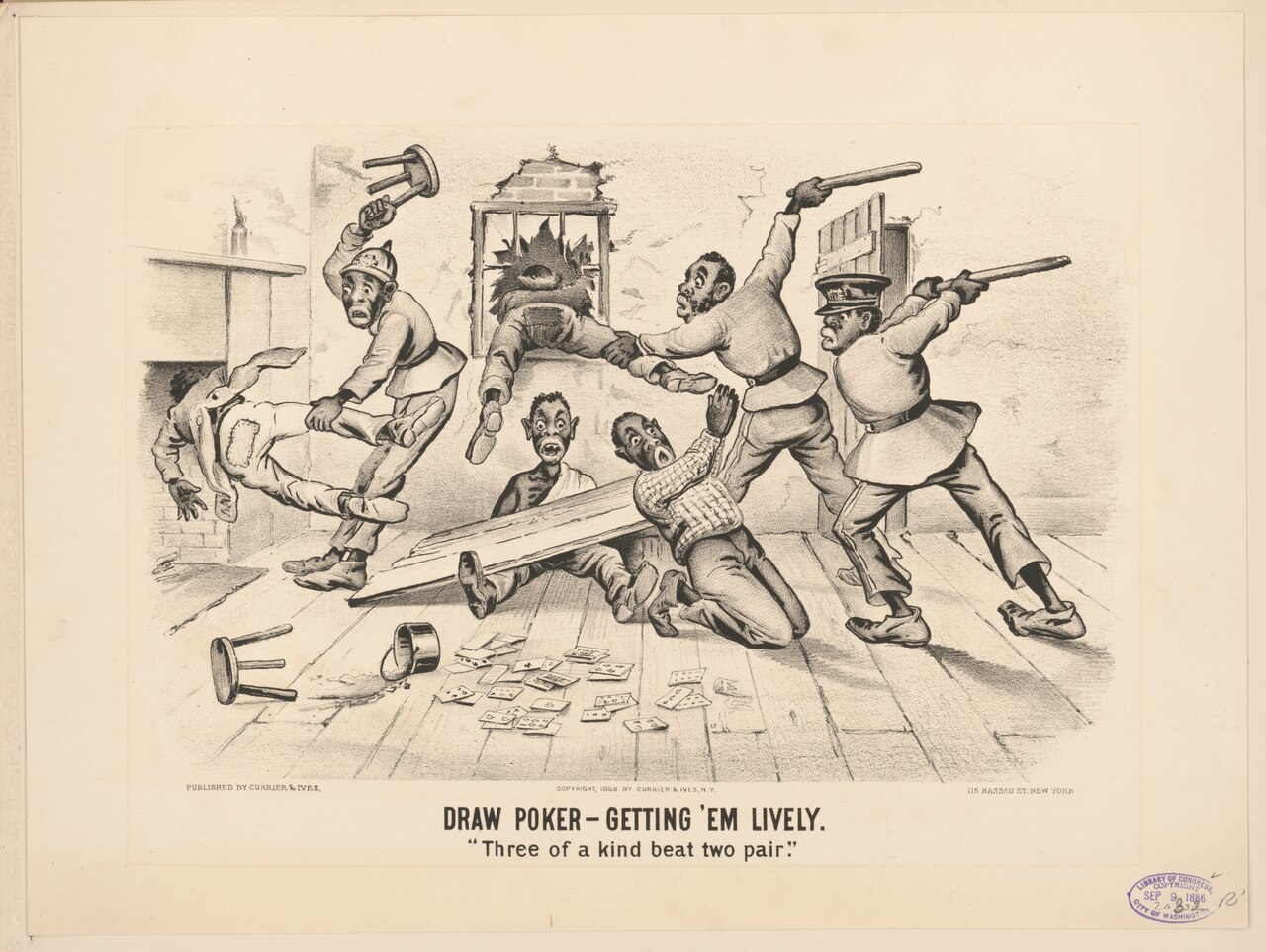
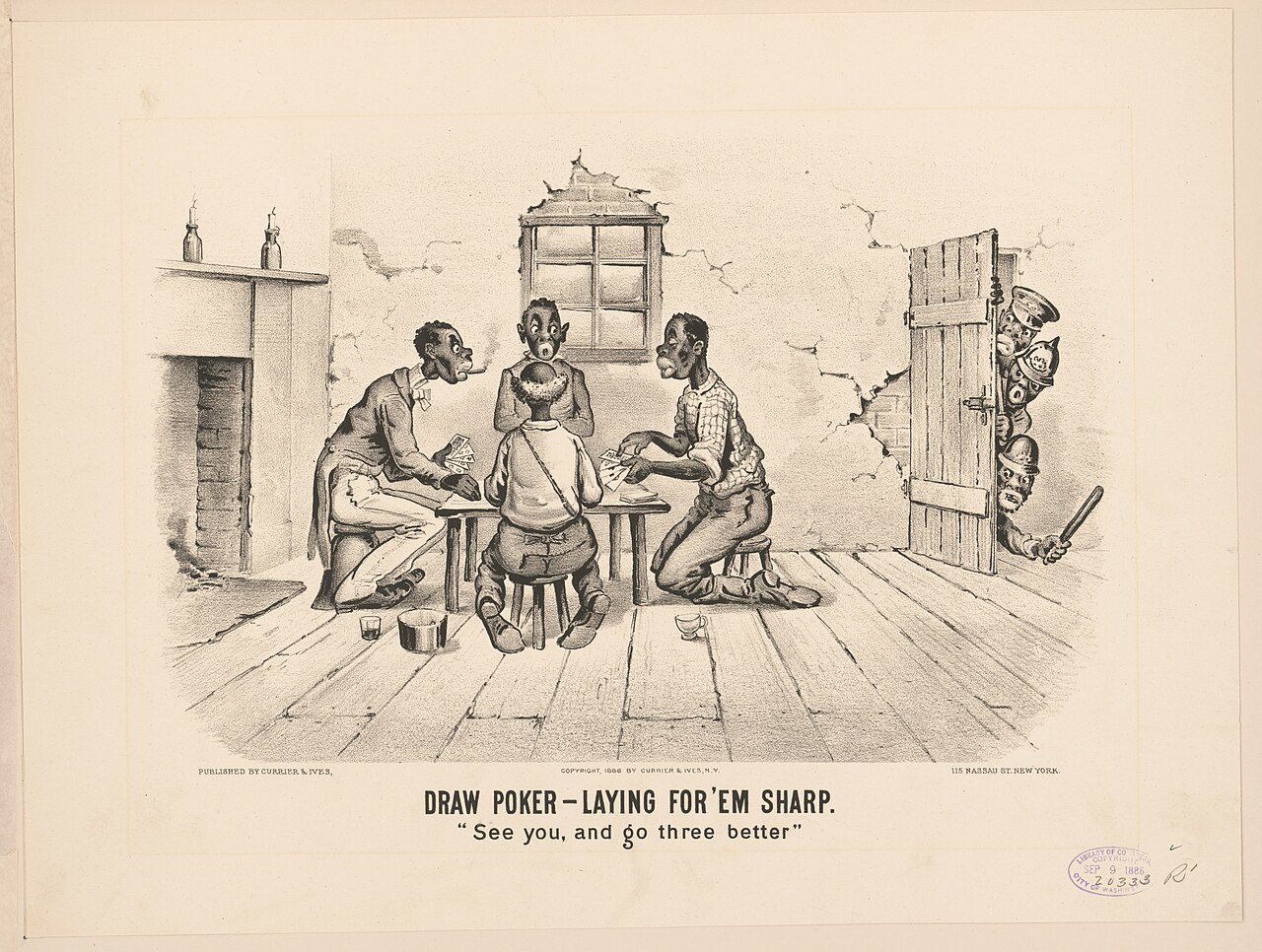
Currier & Ives. · Public domain
Draw poker is a family of poker variants in which each player receives a complete hand before the first betting round and then improves it by replacing, or 'drawing,' cards. It is one of the oldest and most widely played forms of poker, especially in home games, and includes numerous sub-variants such as five-card draw, lowball games, and high-low split games.
- field
- Card games / Poker variants
- known_for
- Being the foundational form of poker where players draw new cards to improve their hands
- common_variants
- Standard five-card draw, Gardena jackpots, California lowball, Kansas City lowball, Badugi, Baduci, high/low split
Lore & Background
Draw poker is defined by the initial deal of a complete hand to each player, followed by one or more drawing rounds where players may discard and replace cards. The most common form is standard five-card draw, often the first variant learned by players and popular in home games, though now rare in casinos and tournaments. Betting structures vary: home games typically use antes with betting starting to the dealer's left, while casino play uses blinds with positional betting.
Reader's Guide
Draw poker encompasses a wide range of games that have shaped poker history. Gardena jackpots, also called 'Jacks to open,' introduced an opening requirement of a pair of jacks or better and a winning requirement of three of a kind or better, leading to large pots and the term 'jackpot.' California lowball, using ace-to-five low values and a joker, was the primary game in Gardena during the 1970s. Kansas City lowball uses deuce-to-seven low values without a joker and is often played no-limit. Triple-draw lowball variants have gained popularity in serious play, including at the World Series of Poker. Badugi and Baduci are four-card lowball variants with unique hand rankings. High-low split games, with or without declaration, add strategic complexity. Draw poker's legacy includes its role in the development of poker culture, particularly in California, and its continued presence in home games and mixed-game tournaments.
Did You Know?
- Gardena, California, had more public poker tables in the 1930s–1970s than all the rest of the United States combined.
- In progressive jackpots, if a deal is passed out, the opening qualifier rises from jacks to queens, then kings, then aces.
- The strongest possible hand in Gardena jackpots is five aces, achieved with four aces and the joker.
- Badugi is a four-card lowball variant where a 'Badugi' hand has all cards of different ranks and suits.
The Rhythm of a Hand
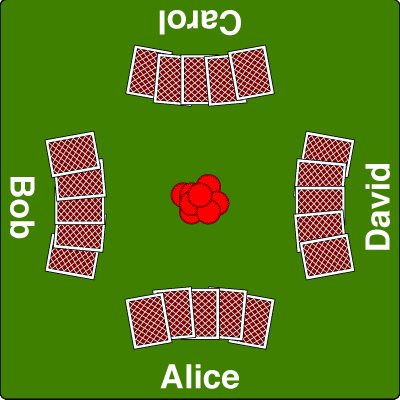
Five-card draw unfolds in a deceptively simple sequence that has made it the default starting point for anyone learning poker. Each player receives five cards dealt one at a time, face down, from a standard fifty-two-card deck. The remaining cards are set aside, typically with a chip or marker placed on top to protect them from accidental disturbance. Players gather their cards, shielding them from view, and the first betting round commences. In a casino setting, action starts with the player seated to the left of the big blind; in a home game using antes, it begins to the dealer's left. Once that round concludes and at least two players remain, the draw phase opens. Each surviving player may discard any number of cards from their hand and receive an equal number of replacements from the top of the deck. A second betting round follows, and if more than one player is still in the hand, a showdown determines which player's best hand claims the pot. The entire cycle—bet, draw, bet, show—gives the game its name and its elegant, compact structure.
House Rules and the Art of Fairness
Because five-card draw thrives in informal home games as much as anywhere else, a rich tradition of house rules has grown around it. One widely adopted convention limits a player to replacing no more than three cards, unless they hold an ace or wild card and draw four. This cap prevents the deck from running dry when many players stay in the draw—a real concern in low-stakes social games but largely irrelevant in casino play. Conversely, casinos often enforce a different restriction: a player may not pull five consecutive cards from the top of the deck. Instead, the dealer deals four cards, lets the other players take their draws, and then returns to give the fifth. If no one else draws, a burn card must be dealt first. Another common safeguard is the rule that the bottom card of the deck is never used as a replacement, eliminating the risk that a player who glimpsed it during the deal could exploit that knowledge. Should the deck be exhausted before every player receives their replacements, the dealer shuffles together the bottom card, the burn card, and earlier players' discards—excluding the last player's own discards—and deals from that pool.
Seven-to-Ace: The Stripped Deck Variant
A distinctive offshoot of five-card draw, commonly called "seven-to-ace" or "ace-to-seven" (abbreviated A-7 or 7-A), compresses the game into a smaller, more volatile format. The variant supports up to five players. With four or fewer at the table, a thirty-two-card deck containing only the ranks from ace through seven is used, with no jokers. When a fifth player joins, the sixes are added to create a thirty-six-card deck. The result is a table with just eight or nine distinct ranks instead of the thirteen found in a standard deck, which dramatically shifts the odds of assembling particular hands. Most notably, the hand hierarchy is altered: a flush now outranks a full house while still sitting below four of a kind. This compressed probability space makes the game feel faster and more unpredictable. Despite its mathematical elegance, seven-to-ace has found its home almost exclusively in the digital world. Smaller online poker operators, such as Boss Media, have popularized the variant, yet it remains virtually unknown in brick-and-mortar casinos. For players who crave the draw mechanic without the full breadth of a fifty-two-card deck, A-7 offers a tight, focused alternative.
The Mathematics Beneath the Cards
The pre-draw odds in five-card draw paint a striking picture of how rare the coveted hands truly are. A royal flush appears with a probability of less than one in a hundred thousand, while even a straight flush (excluding the royal) stays below two in a hundred thousand. Four of a kind lands at just 0.02 percent, and a full house at 0.14 percent. Flushes and straights, often celebrated in popular culture, each sit around the 0.2 to 0.4 percent range. Three of a kind is more attainable at 2.11 percent, and two pair at 4.75 percent. The most common made hand is a single pair, which arrives roughly 42.3 percent of the time. But the most frequent outcome of all is actually "nothing"—a hand with no pair, no straight, no flush—occurring in over 50 percent of deals. This distribution explains why the draw phase is so critical: a player starting with nothing has a mathematical incentive to discard and reshuffle, while one holding a pair or better must weigh the risk of breaking a decent hand against the slim chance of improving it. The numbers also underscore why five-card draw, despite its simplicity, carries genuine strategic depth.
Gallery

More in Card Games 1-22
Spotted an error? Know more?
This is a living reference — every entry is fact-audited, and reader corrections feed straight into our audit queue. Suggest an edit · See this site's audit record