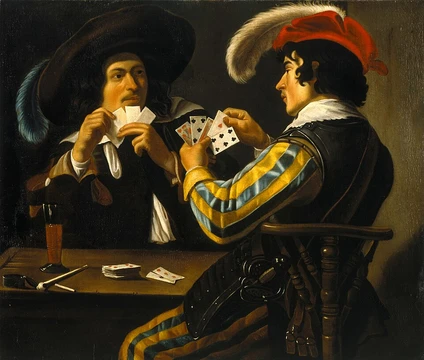
Standard 52-card deck
The most common playing card deck used worldwide.

The standard 52-card deck of French-suited playing cards is the most common pack of playing cards used today. It comprises 13 ranks in each of four suits: clubs, diamonds, hearts, and spades, with each suit including three court cards (King, Queen, Jack) and ten numeral cards from one (Ace) to ten. The deck is double-sided, with identical backs to conceal card identity and unique faces displaying suit and rank.
- composition
- 52 cards: 4 suits × 13 ranks (Ace, 2–10, Jack, Queen, King)
- suits
- Clubs (♣), Diamonds (♦), Hearts (♥), Spades (♠)
- jokers
- Usually 2–3 since mid-20th century, not part of standard 52
- common_patterns
- English pattern (international), Belgian–Genoese pattern, others
Lore & Background
Britain began manufacturing its own cards in London toward the end of the 16th century, based on the Rouen pattern but dropping names on court cards. The English pattern evolved, losing some Rouen elegance and becoming more stylized, with figures taking more space and many details distorted.
Reader's Guide
The standard 52-card French-suited deck is the predominant traditional pack for card games in English-speaking countries and is used internationally. The deck is delivered in New Deck Order (NDO): two Jokers (if any), then Ace-to-King of Spades, Ace-to-King of Diamonds, then King-to-Ace of Clubs, and King-to-Ace of Hearts. NDO aids quality control, gives a perception of freshness, and is useful for card tricks. The English pattern is the most popular design worldwide, while regional patterns like Belgian–Genoese are used in parts of Europe, North Africa, the Middle East, and the Balkans. Deck sizes vary by region, with 36-, 40-, 48-, and 52-card packs common.
Did You Know?
- New Deck Order (NDO) starts with Jokers, then Ace-to-King of Spades and Diamonds, then King-to-Ace of Clubs and Hearts.
More in Card Games 1-22
Spotted an error? Know more?
This is a living reference — every entry is fact-audited, and reader corrections feed straight into our audit queue. Suggest an edit · See this site's audit record