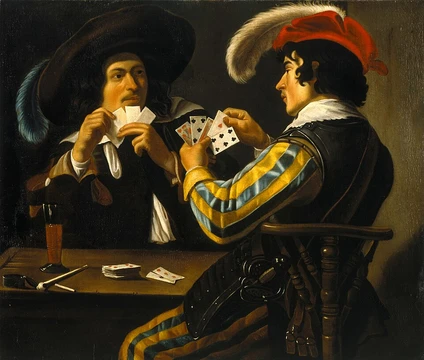
Tarot card games
Trick-taking games with a permanent trump suit, originating in Italy.

Tarot card games are trick-taking games played with specialized tarot packs that include a permanent trump suit alongside the usual four suits. Originating in Italy, they spread across Europe and remain popular in France, Austria, Italy, and several other countries, with regional variations in deck composition and rules.
- earliest_known_deck
- c. 1420, ordered by Filippo Maria Visconti with 16 trumps
- earliest_rule_description
- 1637, by Abbé de Marolles in Nevers
- common_deck_sizes
- 78, 66, 63, 54, 40, or 36 cards
- typical_number_of_players
- 2 to 8, most commonly 3 or 4
- key_regions
- France, Austria, Italy, Hungary, Slovenia, Czechia, Slovakia, Switzerland, Denmark, south Germany, south Poland
- notable_variant
- Königrufen in Austria
Lore & Background
The introduction of trumps, initially called trionfi, is one of only two major innovations to trick-taking games since their invention, the other being bidding. The earliest known example of a fifth suit of trumps was ordered by Filippo Maria Visconti around 1420 and included 16 trumps with images of Greek and Roman gods. Tarot decks did not precede decks having four suits of the same length, and they were invented not for occult purposes but purely for gaming.
Reader's Guide
Tarot games are increasingly popular in Europe, especially in France where French tarot is the second most popular card game after Belote. In Austria, Tarock games, especially Königrufen, have become widespread with several major national and international tournaments each year. Italy, the home of tarot, remains a stronghold. Games of the tarot family are also played in Hungary, Slovenia, Liechtenstein, Czechia, Slovakia, Switzerland, Denmark, south Germany and south Poland. The earliest detailed description of rules for a tarot game was published by the Abbé de Marolles in Nevers in 1637, describing a three-player variant with a 66-card pack. As a result, tarot cards have since been used for cartomancy and divination as well as gaming, though fortune-tellers now tend to use specially developed decks rather than those used for games.
Did You Know?
- The earliest known tarot deck with trumps was ordered by Filippo Maria Visconti around 1420.
- The first detailed rules for a tarot game were published in 1637 by the Abbé de Marolles.
- In Austrian Tarock, the three highest trumps (Sküs, Mond, Pagat) are collectively called the Trull or Honours.
More in Card Games 1-22
Spotted an error? Know more?
This is a living reference — every entry is fact-audited, and reader corrections feed straight into our audit queue. Suggest an edit · See this site's audit record