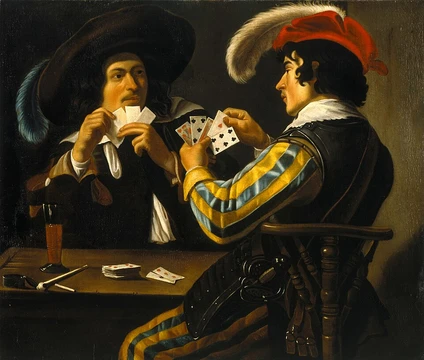
Trick-taking game
Card- or tile-based games centered on winning tricks.

A trick-taking game is a card- or tile-based game in which play of a hand centers on a series of finite rounds called tricks, each evaluated to determine a winner. The object may be tied to the number of tricks taken, as in plain-trick games such as contract bridge, whist, and spades, or to the value of cards in taken tricks, as in point-trick games such as pinochle, the tarot family, briscola, and most evasion games like hearts. Trick-and-draw games allow players to fill up their hands after each trick, while trick-avoidance games like reversis or polignac aim to avoid taking some or all tricks. The domino game Texas 42 is an example of a trick-taking game that is not a card game.
- earliest known European game
- Karnöffel, mentioned in 1426 in Nördlingen
- first mention of playing cards in Europe
- Spain, 1371
- invention of trumps
- 15th century
- invention of bidding
- 17th century
- most popular 17th-century game
- ombre
- most popular 18th-century game
- tarot
- last global trick-taking game
- contract bridge
Lore & Background
The earliest card games were trick-taking games, originating from ancient China and spreading westwards during the early second millennium. Michael Dummett noted they were played without trumps, following suit was not required, rotation was counter-clockwise, they were plain-trick games, and pip cards of one or more suits were in reverse order. Two revolutions in European trick-taking games led to more sophisticated games: the invention of trumps and the requirement of following suit in the 15th century, and bidding in the 17th century.
Reader's Guide
Trick-taking games have shaped the history of card games globally. The invention of trumps around 1440 in Italy, with special cards called trionfi (later tarots), created a fifth suit with a fixed hierarchy, a feature retroactively added to some games. Bidding for a trump suit, credited to ombre in the 17th century, allowed players to auction for the trump suit rather than having it randomly selected. In the 20th century, whist with bidding and the dummy hand developed into contract bridge, the last global trick-taking game. Point-trick games, at least as old as tarot decks, assign counting values to cards, with most belonging to the ace–ten family beginning with brusquembille. Chinese trick-taking games did not develop trumps or bidding, instead diverging into multi-trick games that evolved into draw-and-discard games and climbing games like Zheng Shangyou and dou dizhu.
Did You Know?
- The oldest known European trick-taking game, Karnöffel, was mentioned in 1426 in the Bavarian town Nördlingen.
- The invention of trumps is credited to special cards called trionfi introduced around 1440 in Italy.
- Bidding for a trump suit was invented in the 17th-century game ombre.
- The domino game Texas 42 is an example of a trick-taking game that is not a card game.
More in Card Games 1-22
Spotted an error? Know more?
This is a living reference — every entry is fact-audited, and reader corrections feed straight into our audit queue. Suggest an edit · See this site's audit record