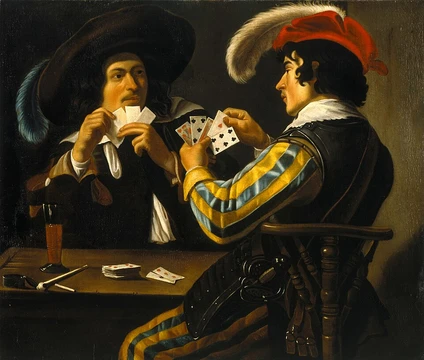
Whist
Classic English trick-taking card game of the 18th and 19th centuries.

Whist is a classic English trick-taking card game that was widely played in the 18th and 19th centuries. Although the rules are simple, there is scope for strategic play. The game takes its name from the 17th-century word whist (or wist) meaning quiet, silent, attentive, which is the root of the modern wistful.
- Origin
- England
- First described
- 1674 in The Complete Gamester as a version of Ruff and Honours
- Peak popularity
- 18th and 19th centuries
- Governing bodies
- The Portland Club (London) and The Whist Club (New York)
- Replaced by
- Bridge in the early 1890s
Lore & Background
Whist evolved from earlier games such as Ruff and Honours, described in 1674 as the most popular descendant of Triumph. By the 18th century, Whist, played with a 52-card pack, superseded Ruff and Honours. Jones outlined a comprehensive history, suggesting ancestors including a game called Trionf mentioned by a sixteenth century Italian poet named Berni, and a game called Trump (or Triumph) mentioned in Shakespeare's Antony and Cleopatra. Many subsequent editions were published using the simpler title Cavendish on Whist. By the later 19th century, official rules of Short Whist were maintained by The Portland Club in London and The Whist Club in New York. In the early 1890s, Whist was quickly replaced by the new game of Bridge in clubs. Whist was still played as a social game, in club individual duplicate cardplay competitions, and later at charitable social events called whist drives.
Reader's Guide
Whist's significance lies in its role as the direct predecessor of modern contract bridge and as a game that formalized trick-taking conventions. These works established elaborate and rigid rules covering the laws of the game, etiquette, and play, which took time to study and master. Whist introduced conventions for leading and signaling that allowed partners to communicate information about their hands without bidding, a system that influenced later games. The game's scoring system, including the concept of odd tricks, games, and rubbers, was carried into bridge. Whist also spawned numerous variants, including Bid whist, Dutch whist, and others classified into auction whist, Boston, classic whist, and exact bidding groups. Although replaced by bridge in clubs by the early 1890s, Whist persisted as a social game and in charitable whist drives, and its basic rules remain playable online today.
Did You Know?
- The name 'whist' comes from a 17th-century word meaning quiet, silent, attentive.
- In the early 1890s, Whist was quickly replaced by the new game of Bridge in clubs.
- The superior American system of leads and signals was adopted in the last edition of Cavendish.
More in Card Games 1-22
Spotted an error? Know more?
This is a living reference — every entry is fact-audited, and reader corrections feed straight into our audit queue. Suggest an edit · See this site's audit record